Home › Services
Line striping, layout and accessible parking
Striping is the cheapest thing on a lot and the most visible, and it is where accessibility stops being theoretical.
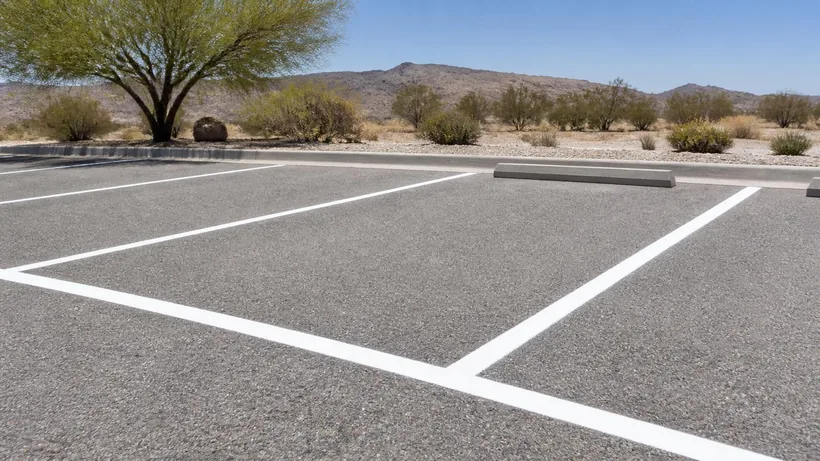
What striping is doing
Paint on a parking lot is doing three separate jobs, and they pull in different directions.
It organizes the site: stalls, aisles, direction of travel, loading zones, fire lanes, pedestrian routes. A well-laid-out lot moves more vehicles with less conflict, and the layout is worth more than the paint.
It communicates requirements: accessible stalls and access aisles, no-parking zones, signage-supported restrictions.
And it signals maintenance. A freshly striped lot reads as a cared-for property in a way that is out of all proportion to what it cost, which is why striping is the single highest-impact cosmetic spend on a commercial site.
Accessible parking is a compliance matter
This is the part of striping that carries consequences beyond appearance, and it is the reason a restripe is not automatically a repaint of what was there.
Stall and access aisle dimensions, the number of accessible spaces relative to the total stall count, van-accessible provision, the route from the space to the accessible entrance, and supporting signage are all regulated matters rather than layout preferences.
Two practical implications. First, faded accessible markings are an exposure rather than an untidiness. Second, a lot laid out decades ago may not reflect current expectations, and repainting the existing layout reproduces whatever was wrong with it.
Requirements are matters for the authority having jurisdiction and for your own advisers. What a contractor can do is raise the question at the point where it becomes physical, which is the striping stage.
Layout is worth more than paint
Restriping is the cheapest moment to reconsider a layout, because the marginal cost of painting a better arrangement is essentially zero.
Things worth looking at: whether stall count can be improved with a different angle, whether drive aisle widths are doing the property any favors, whether the traffic flow creates conflicts at the entrance, whether pedestrians have a sensible route from the far corner to the door, and whether the loading arrangement still matches how the property is actually used.
Properties change use over decades and layouts frequently do not follow. The restripe is when that gets fixed, or when it gets locked in for another cycle.
Paint in Arizona sun
Ultraviolet exposure is hard on traffic paint, and Valley lots fade faster than lots in milder climates.
Wear is also uneven, which matters for planning. Paint in a busy drive aisle is worn by traffic as well as sun; paint in a quiet corner of the lot fades but is not abraded. A lot can look acceptable overall while the markings that matter most — the ones people drive over — are the ones that have gone.
Surface condition affects how long paint lasts as much as the paint does. Striping over a raveling, oxidized surface gives the paint nothing sound to hold, and it will not last however good the material is.
Surface temperature matters during application too, and in a Valley summer that frequently means working early rather than through the middle of the day.
Sequencing: striping goes last
This sounds obvious and it is routinely got wrong.
Paint goes on the finished surface. Striping before crack sealing, patching, resurfacing or sealcoating means paying to do it twice, because every one of those operations covers or disturbs the markings.
New asphalt also needs to cure before paint is applied. Striping too early on a new surface produces markings that do not hold, which is a wasted pass rather than a saving.
The one time striping is genuinely standalone is on a sound, well-maintained surface where nothing else is due. That is a good position to be in, and it is worth knowing whether you are actually in it before booking the work.
What a good striping plan covers
- A layout drawing rather than an assumption that the old lines will be reproduced.
- Stall count, angle and aisle widths, and whether they suit the current use of the property.
- Accessible stall count, dimensions, access aisles, routes and signage.
- Fire lanes and any other regulated markings.
- Directional arrows, stop bars and crosswalks where the traffic pattern needs them.
- Loading zones, reserved spaces and anything tenant-specific.
- Phasing, so the site stays usable while paint cures.
Line striping, layout and accessible parking — common questions
How often does a Phoenix lot need restriping?
More often than in milder climates, because ultraviolet exposure is hard on traffic paint. Wear is uneven too — drive aisles go first because they take traffic as well as sun, so the markings people actually drive over are the ones that fade soonest.
Can you just repaint the existing layout?
You can, and it is worth asking whether you should. A layout from decades ago may not reflect how the property is used now or current accessible parking expectations, and repainting it locks that in for another cycle.
Are faded accessible parking markings a problem?
They are a compliance exposure rather than an appearance issue. Accessible stall dimensions, access aisles, counts, routes and signage are regulated matters, and the striping stage is where they become physical.
Should striping happen before or after sealcoating?
After, always. Sealcoating covers paint. The same applies to patching, crack sealing and resurfacing — striping goes on the finished surface or you pay to do it twice.
How soon can a new lot be striped?
New asphalt needs to cure first, or the paint will not hold. The interval depends on conditions and it is worth confirming rather than assuming, because striping early is a wasted pass.
Will striping last on a worn surface?
Not well. Paint applied to a raveling, oxidized surface has nothing sound to bond to and will fail regardless of material quality. If the surface is that far gone, the surface is the thing to address.
Can we add stalls by restriping?
Sometimes, by changing the angle or the aisle arrangement, and the restripe is the cheapest moment to explore it because the marginal cost of painting a better layout is essentially nothing.
Does the lot need to close for striping?
In phases only. Painted areas need time before traffic, and the plan usually works section by section so the property keeps operating throughout.
Talk through your site
Start with the address, roughly how many square feet, and photographs of the worst areas and anywhere water sits after rain.
Related work
Asphalt Repair
Potholes, alligatored areas, failed patches and what each one says about the base.
Parking Lot Paving
New lots and full reconstruction, from subgrade up.
Sealcoating
What it does, what it does not, and when it is money wasted.
Resurfacing & Overlay
Overlay, mill-and-fill, and telling a surface problem from a base problem.
Asphalt Driveways
Residential drives, repairs and resurfacing across the Valley.
Where we do it
Phoenix
The core: commercial, industrial, retail and multifamily lots.
Scottsdale
Higher finish expectations and tighter appearance standards.
Mesa
Large sites, older lots and a lot of deferred maintenance.
Glendale
Event traffic, big lots and heavy seasonal loading.
Tempe
Dense, constrained sites where phasing matters more than price.
Chandler
Tech and industrial campuses with heavy vehicle loading.