Home › Services
Asphalt repair across the Valley
The question is never how to fill the hole. It is why the hole appeared there.
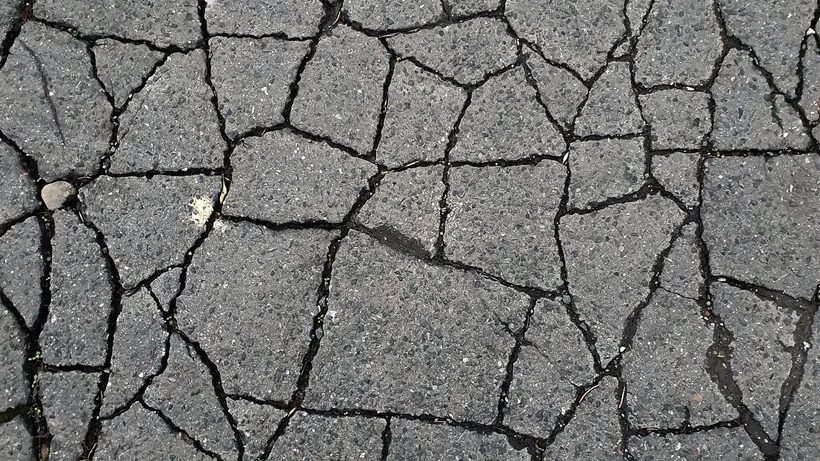
Surface problem or base problem
Every asphalt repair decision starts here, and getting it wrong is the most expensive routine mistake in commercial property maintenance.
Asphalt is a flexible system: compacted subgrade, an aggregate base that spreads wheel loads, and a wearing course on top. Distress that begins at the surface — oxidation, raveling, thermal cracking — responds to surface treatment. Distress that begins underneath does not, and no amount of material applied on top will change that.
The practical test is the pattern. Isolated single cracks tend to be surface-origin. Interconnected cracking in a pattern like reptile skin, concentrated in wheel paths or turning areas, is the base flexing under load. Depressions that hold water after rain are usually telling you about what is underneath rather than what is on top.
Full-depth repair, and why it costs what it does
Where the base has failed, the only repair that works is to remove the pavement and the compromised base, address whatever caused it, and rebuild from the bottom.
That means saw-cutting a clean perimeter beyond the visible damage, excavating to sound material, correcting the subgrade if that is the issue, placing and compacting new base, then paving back in lifts and compacting properly.
It is more expensive per square foot than surface work by a wide margin, and owners frequently react to that with disbelief because the visible area is small. The visible area is the part that finished failing. The repair is sized to the part that has failed structurally, which is always larger.
Cutting the repair short — patching only what is visible — produces a patch that fails at its own edges within a season or two, because it has been placed partly on ground that was already going.
Why patches keep failing in the same place
A patch that has been replaced two or three times is not a workmanship story. It is a diagnostic result.
It means the cause has never been addressed. Usually that is water — getting into the base and not getting out, softening material that then cannot carry load. Sometimes it is loading, where a dumpster pad or a delivery route sees weight the pavement was never designed for. Occasionally it is subgrade that moves with moisture.
The useful response is to stop buying patches and ask what is putting water there, or what is driving over it. That conversation costs nothing and it is the only thing that ends the cycle.
Crack sealing, done at the right time
Crack sealing is one of the highest-return things you can do to a sound pavement, and one of the most pointless things you can do to a failing one.
On a structurally sound lot, an open crack is a direct route for water into the base. Sealing it keeps the structure dry and genuinely extends pavement life for a modest cost. Done on a regular cycle, it is the cheapest form of asphalt maintenance there is.
On an alligatored area it achieves nothing, because the cracking is a symptom of the base already having failed. Sealing the pattern is sealing the evidence.
Timing matters in the Valley too. Cracks are at their widest when the pavement is cool, which affects when sealant can be placed to fill properly rather than bridging a narrowed gap that will reopen.
Drainage is a repair item
This is the part owners least expect on a repair proposal and the part that most determines whether the repair lasts.
Water that sits on asphalt finds its way in. Water in the base softens it. Softened base cannot carry load, and the pavement above breaks up. That is the entire mechanism behind most base failure in the Valley, and it is driven by monsoon rain arriving in volume rather than by steady weather.
So a repair in a low spot that has not addressed why the low spot holds water is a repair with a short expected life. Correcting grade, restoring positive drainage to inlets, and making sure water has somewhere to go is unglamorous and it is the difference between a repair and a recurring cost.
Keeping the site open during repairs
Most repair work is spot work, which makes it far easier to phase than a full resurfacing. That is an advantage worth using.
Individual repair areas can usually be isolated with barricades while the rest of the lot operates, and cure times before an area can take traffic vary by material and by temperature.
What to agree in advance: which areas are closed when, how traffic and pedestrians are routed around them, how accessible parking is maintained throughout, and when each area can take traffic again. The last one matters more in summer than owners expect.
Asphalt repair across the Valley — common questions
Why does my pothole keep coming back?
Because the cause has not been addressed. Usually water getting into the base and not getting out, sometimes loading the pavement was never designed for. Filling it again without answering that is a subscription rather than a repair.
Can alligator cracking be sealed?
No. It means the base underneath has failed and the pavement is flexing under load. Sealing the pattern seals the evidence. The area has to be removed, the base repaired, and new asphalt placed.
Why is the repair area bigger than the damage?
Because the visible damage is where failure finished, not where it starts. A repair cut tight to the visible edge sits partly on ground that is already going, which is why those patches fail at their own edges within a season or two.
Is crack sealing worth it?
On a structurally sound lot it is the highest-return maintenance available, because an open crack is a direct route for water into the base. On an alligatored area it achieves nothing at all.
How quickly should I deal with a pothole?
Promptly, because it is an open route for water into the base and it grows. It is also a trip and vehicle damage exposure, which is a separate reason not to leave it.
Does the repair have to match the rest of the lot?
New asphalt is darker than aged asphalt and will stay visibly different for a while. If appearance matters, that is a reason to consider a surface treatment across the lot once the structural work is complete — in that order, not the reverse.
Can repairs be done in summer?
Yes, though heat affects cure and how soon an area can take traffic. Work is often scheduled around the hottest part of the day rather than deferred to another season.
Should I repair or just resurface the whole lot?
Resurfacing over failed base reproduces the failure through the new surface, usually within a couple of years. Structural repairs come first; resurfacing is a decision about the surface once the structure is sound.
Talk through your site
Start with the address, roughly how many square feet, and photographs of the worst areas and anywhere water sits after rain.
Related work
Parking Lot Paving
New lots and full reconstruction, from subgrade up.
Line Striping & Layout
Layout, stall counts, accessible parking and keeping paint alive in Phoenix sun.
Sealcoating
What it does, what it does not, and when it is money wasted.
Resurfacing & Overlay
Overlay, mill-and-fill, and telling a surface problem from a base problem.
Asphalt Driveways
Residential drives, repairs and resurfacing across the Valley.
Where we do it
Phoenix
The core: commercial, industrial, retail and multifamily lots.
Scottsdale
Higher finish expectations and tighter appearance standards.
Mesa
Large sites, older lots and a lot of deferred maintenance.
Glendale
Event traffic, big lots and heavy seasonal loading.
Tempe
Dense, constrained sites where phasing matters more than price.
Chandler
Tech and industrial campuses with heavy vehicle loading.