Home › Services
Resurfacing: overlay, mill-and-fill, and knowing which
Resurfacing renews a surface. It does nothing for what is underneath, and the whole decision turns on that.
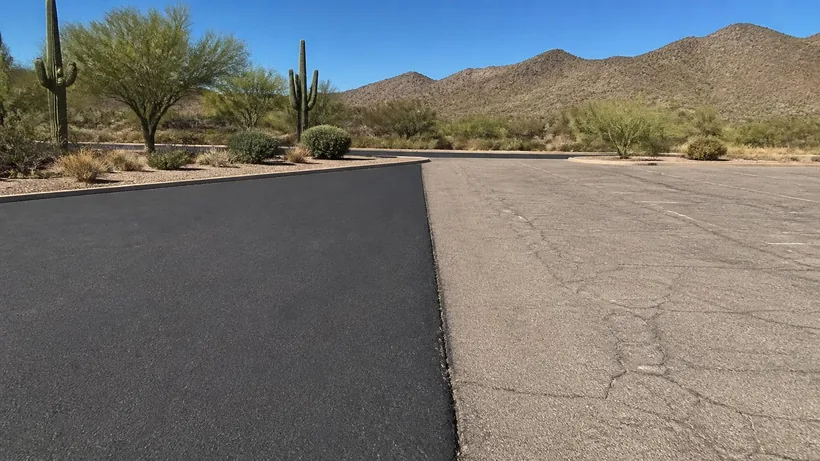
The two approaches
An overlay places new asphalt on top of the existing surface. It is faster and cheaper, it requires less equipment, and it raises the finished grade by the thickness of the new material.
Mill-and-fill grinds off a layer of the existing surface first, then paves back. It costs more because of the milling and the material hauled away, and it keeps the finished elevation where it was.
The choice is not about budget in the way owners assume. It is about what is underneath and about whether the lot can afford to get taller.
Why grade matters more than it sounds
Raising a parking lot surface has consequences at every edge and every transition.
Curb reveal decreases, which can leave curbs too low to function and can create a lip where none was intended. Door thresholds and building entries get closer to the pavement, which is a water issue before it is anything else. Drainage inlets and valley gutters end up sitting proud or being buried. Transitions to adjacent concrete, ramps and sidewalks stop matching.
Accessible routes are the serious version of this. Slopes at accessible parking, access aisles and the route to the entrance are regulated, and raising a surface changes them.
On a site with generous curb reveal and no tight transitions, an overlay is straightforward. On a constrained site with doors close to grade, it can create more problems than it solves, and milling is the answer whether or not it is the cheaper line item.
Reflective cracking
This is the thing owners are most often not told about overlays.
Cracks in the existing pavement do not disappear because new asphalt has been placed over them. The movement that produced them continues, and the crack works its way up through the new surface — frequently within a couple of years, in the same pattern.
Milling removes the cracked material rather than burying it, which is one of the main structural arguments for it. Treatments exist to slow reflection, and none of them stop the movement underneath.
So an overlay on a badly cracked lot is buying a smooth surface for a defined and often short period. That can be a legitimate commercial decision. It is only a bad decision when nobody said so beforehand.
When resurfacing is the wrong answer entirely
Resurfacing addresses the surface. If the base has failed, it does not help, and the new surface fails in the same places the old one did.
The signals are the same ones that appear everywhere on this site: alligator cracking, depressions that hold water, patches that keep failing, potholes recurring in the same spots.
Where those are present, they need full-depth repair before resurfacing — or, if they are widespread, the honest answer is reconstruction rather than a new surface over a failed structure.
The most expensive version of this mistake is resurfacing a whole lot with failed areas untreated. It looks like a major investment, and the failures come back through within a season or two.
What a proper resurfacing job includes
- An assessment of what is underneath, not just a measurement of what is on top.
- Full-depth repair of any structurally failed areas before the new surface goes on.
- A decision on overlay versus milling made on grade constraints and existing condition rather than on price alone.
- Attention to transitions: curbs, gutters, inlets, doorways, ramps and adjacent concrete.
- Proper compaction of the new mat, which determines how long it lasts.
- Restriping afterwards, including a look at whether the old layout is still the right one.
Scheduling and heat
Paving in Valley summer is routine, and temperature affects how the mat cools and how soon it can take traffic. That is a phasing input rather than a reason to defer.
Most commercial sites resurface in sections so the property keeps trading. Each section needs to be closed to traffic until the surface can carry load, and that window is longer or shorter depending on conditions.
Striping follows once the new surface has cured enough to hold paint, which means the lot is usable before it is finished, and that gap is worth planning for rather than being surprised by.
Resurfacing — common questions
What is the difference between an overlay and mill-and-fill?
An overlay adds new asphalt on top and raises the grade. Mill-and-fill grinds the old surface off first and keeps the elevation. Milling costs more and removes deteriorated material rather than burying it.
Will cracks come back through an overlay?
Frequently, yes — it is called reflective cracking, and it happens because the movement that produced the original cracks continues. Milling removes the cracked material instead, which is the main structural argument for it.
Why does raising the grade matter?
Curb reveal decreases, door thresholds get closer to the pavement, inlets and gutters stop matching, and transitions to concrete no longer line up. On accessible routes the slopes are regulated, so changing the surface height changes a compliance item.
Can we resurface over potholes and alligatored areas?
Not sensibly. Those are structural failures, and a new surface over them fails in the same places, usually within a season or two. Full-depth repair comes first, or reconstruction if they are widespread.
How long does a resurfaced lot last?
It depends almost entirely on what is underneath and on how well the new mat was compacted. A good surface over a sound structure lasts well; the same surface over a failing base does not, regardless of workmanship.
Can the lot stay open?
In phases. Each section needs to be closed until the new surface can take traffic, and that window varies with temperature. Striping follows after cure, so there is a period where the lot is usable but not finished.
Is resurfacing cheaper than reconstruction?
Substantially, which is exactly why it gets chosen when reconstruction is what the lot needs. On a structurally failed lot it is deferral rather than a saving.
Should we restripe the old layout after resurfacing?
It is the cheapest moment to reconsider it. Stall angles, aisle widths, traffic flow and accessible parking provision are all worth reviewing rather than reproducing by default.
Talk through your site
Start with the address, roughly how many square feet, and photographs of the worst areas and anywhere water sits after rain.
Related work
Asphalt Repair
Potholes, alligatored areas, failed patches and what each one says about the base.
Parking Lot Paving
New lots and full reconstruction, from subgrade up.
Line Striping & Layout
Layout, stall counts, accessible parking and keeping paint alive in Phoenix sun.
Sealcoating
What it does, what it does not, and when it is money wasted.
Asphalt Driveways
Residential drives, repairs and resurfacing across the Valley.
Where we do it
Phoenix
The core: commercial, industrial, retail and multifamily lots.
Scottsdale
Higher finish expectations and tighter appearance standards.
Mesa
Large sites, older lots and a lot of deferred maintenance.
Glendale
Event traffic, big lots and heavy seasonal loading.
Tempe
Dense, constrained sites where phasing matters more than price.
Chandler
Tech and industrial campuses with heavy vehicle loading.