Home › Services
Parking lot paving and reconstruction
A parking lot is a structure. Most of what determines how long it lasts is buried before anyone sees asphalt.
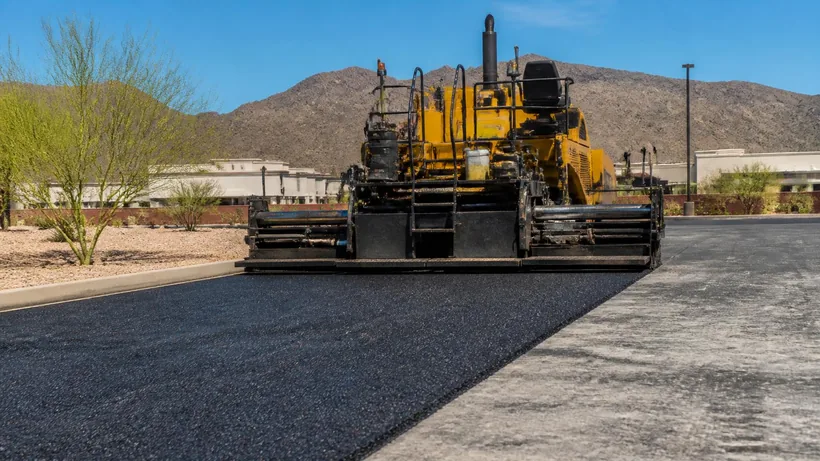
What is actually being built
A new lot is three layers and a drainage plan, and the asphalt is the least of them.
The subgrade is prepared and compacted native soil. Its condition and its moisture behavior determine what everything above has to do. In parts of the Valley, soils move with moisture content, and where that is the case it is a design input rather than a detail.
The aggregate base is compacted stone. This is the structural layer. It takes concentrated wheel loads and spreads them across the subgrade so that no point is overloaded. Depth and compaction here do more for pavement life than anything happening above.
The asphalt is the wearing course: a smooth, sealed, durable surface that also keeps water out of everything beneath it.
When a lot fails early, the cause is almost always in the first two layers, which is exactly where the money is invisible and therefore where it gets cut.
Designing for the traffic it will actually see
The single most common design failure in commercial paving is treating a whole lot as one pavement.
A parking stall carries a stationary car. A drive aisle carries constant movement. A truck route carries loads an order of magnitude higher. A dumpster pad carries a heavy vehicle stopping, lifting and turning in exactly the same footprint every week. A drive-through lane carries slow, braking, turning traffic on the same line all day.
Those are different structural demands, and pavements built to a single specification across a site fail first in the heaviest-loaded areas — predictably, in the same places, on every site built that way.
Getting this right means identifying the loading zones during design and building each area to what it is going to carry. It costs more up front and it is the difference between a lot that ages evenly and one that needs structural repair at the dumpster pad in year three.
Concrete where concrete belongs
There are places on an asphalt site where asphalt is the wrong material, and a contractor who says so is doing you a favor.
Dumpster pads are the clearest case. A refuse truck stopping, lowering, lifting and pulling away on the same spot applies loads and shear that deform asphalt, particularly in summer heat. A concrete pad there is standard for good reason.
Drive-through windows, loading dock aprons and areas where heavy vehicles turn slowly are similar candidates. Each is a place where the initial saving from asphalt is repaid in repeated repair.
Drainage is the design, not an accessory
A parking lot is a large impermeable surface, and everything that lands on it has to go somewhere deliberate.
Grades have to move water positively to inlets, without flat spots where it can stand. Inlets have to be located where water actually goes rather than where they were convenient on a drawing. Curb lines, valley gutters and the transitions between them have to work together.
Monsoon rain tests all of this properly, because it arrives in volume rather than gradually. A lot with marginal drainage performs acceptably for most of the year and reveals itself in one afternoon.
Standing water is not a cosmetic complaint. It is water sitting on the route into the base, and it is the beginning of the failure sequence that produces alligator cracking and potholes later.
Reconstruction: when repair no longer makes sense
Full-depth reconstruction — removing pavement and base and rebuilding — is the answer when the structure has failed broadly rather than in identifiable areas.
The signals are a lot where alligator cracking appears across large portions rather than in patches, where patches have been repeated and keep failing, where the grade no longer drains and cannot be corrected by surface work, and where the cumulative cost of repair has started to approach the cost of doing it properly.
It is the expensive option and it is frequently the cheaper one over a ten-year horizon, because everything short of it on a structurally failed lot is deferral with a price tag.
It is also the opportunity to fix the things that caused the failure: drainage, loading zones, and a layout that may have been laid out for a different use than the property has now.
Phasing a live property
Almost no commercial site can close entirely, which makes phasing the real constraint on schedule and a genuine driver of cost.
Paving needs a closed area with no traffic until the mat has cooled and can take load. That window varies with temperature, which in a Phoenix summer is a scheduling input rather than a footnote.
A workable phasing plan settles: how many phases, which areas close in which order, how vehicles and pedestrians route around each, how accessible parking is maintained at every stage, where deliveries go, and what the reopening criteria are for each phase.
The cheapest bid frequently assumes fewer phases than the site can accommodate. That difference reappears as change orders or as a tenant losing trading days, which is usually the larger number.
Parking lot paving and reconstruction — common questions
How thick should the asphalt be?
It depends entirely on what the area will carry — parking stalls, drive aisles, truck routes and loading areas are genuinely different structural problems. A single specification across a whole site is the most common design error and it fails first in the heaviest-loaded areas.
Why does the base matter more than the asphalt?
Because the base is what spreads concentrated wheel loads across the subgrade. The asphalt is a wearing course. When lots fail early the cause is nearly always in the base or subgrade, which is exactly where the work is invisible and where budgets get cut.
Should dumpster pads be asphalt?
Generally not. A refuse truck stopping, lifting and pulling away on the same footprint every week deforms asphalt, especially in summer heat. Concrete there is standard, and the initial saving from asphalt is repaid in repeated repair.
How long should a new lot last?
Long, with maintenance and correct design for the loading it sees; much less than you would expect if either is missing. What matters more than the headline number is whether drainage works and whether heavy-load areas were built for the loads.
Can the lot stay open during paving?
Usually in phases. Paving needs a closed area until the mat cools and can take traffic, and that window depends on temperature. The phasing plan is worth agreeing in detail before work starts.
Is reconstruction really necessary or can we keep patching?
Patching makes sense while failures are identifiable areas. When cracking is widespread, patches keep failing, or the grade no longer drains, continued repair is deferral with a price tag rather than maintenance.
What happens to drainage during reconstruction?
It is the opportunity to fix it, and it should be treated that way. Rebuilding a lot back to the same grades that caused the problem reproduces the problem on a new surface.
How soon can we stripe after paving?
Not immediately — new asphalt needs to cure before paint is applied, or the striping will not hold. The interval depends on conditions, and it is worth confirming rather than assuming, because restriping early is a wasted pass.
Talk through your site
Start with the address, roughly how many square feet, and photographs of the worst areas and anywhere water sits after rain.
Related work
Asphalt Repair
Potholes, alligatored areas, failed patches and what each one says about the base.
Line Striping & Layout
Layout, stall counts, accessible parking and keeping paint alive in Phoenix sun.
Sealcoating
What it does, what it does not, and when it is money wasted.
Resurfacing & Overlay
Overlay, mill-and-fill, and telling a surface problem from a base problem.
Asphalt Driveways
Residential drives, repairs and resurfacing across the Valley.
Where we do it
Phoenix
The core: commercial, industrial, retail and multifamily lots.
Scottsdale
Higher finish expectations and tighter appearance standards.
Mesa
Large sites, older lots and a lot of deferred maintenance.
Glendale
Event traffic, big lots and heavy seasonal loading.
Tempe
Dense, constrained sites where phasing matters more than price.
Chandler
Tech and industrial campuses with heavy vehicle loading.