Home › Services
Asphalt driveways across the Valley
Residential drives are a smaller version of the same problem, with one honest caveat about what Valley homeowners usually choose.
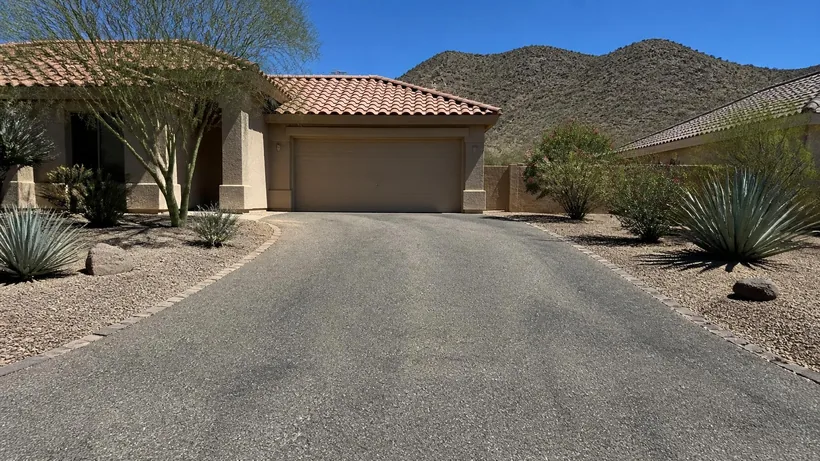
An honest note on materials
Across much of the Phoenix metro, residential driveways are more commonly concrete or pavers than asphalt, and a homeowner comparing options deserves that context rather than a sales pitch.
Asphalt has real advantages: it is generally less expensive to install, it goes down faster, it is easier and cheaper to repair in sections, and it tolerates minor ground movement better than a rigid slab because it flexes rather than cracks.
It also has real disadvantages in this climate: ultraviolet exposure ages it faster than it would elsewhere, summer heat softens the surface, and it wants periodic maintenance to stay in good condition.
Where asphalt makes the most sense is on long drives where the cost difference is meaningful, on rural or semi-rural properties, where ground movement is a factor, and where an existing asphalt drive is already in place and worth maintaining rather than replacing with something else.
How a Valley driveway ages
The sequence is predictable and it is worth recognizing early, because the cheap interventions are all at the beginning of it.
First the surface grays as ultraviolet exposure oxidizes the binder. Then fine cracking appears, usually at the edges and anywhere the drive meets concrete. Then water gets into those cracks and into the base beneath.
In summer, the surface softens enough that vehicle tires — particularly turning in place, or a vehicle parked in the same spot for long periods — leave marks and depressions. Jack stands and trailer tongues do the same thing faster.
Once water has been in the base through a monsoon season or two, the failure becomes structural: alligator cracking in wheel paths, then material breaking out, then a pothole.
The intervention that costs least and helps most is sealing cracks early, before water has had a chance to work on the base.
Edges are the weak point
Driveway edges have no lateral support, which makes them the first thing to crack and crumble on most residential drives.
Vehicles running off the edge, irrigation keeping the ground beside it soft, and vegetation growing at the margin all accelerate it. Once the edge breaks down, water has a route into the base along the whole length.
Keeping the shoulder firm, keeping irrigation off the edge, and dealing with edge cracking early are unglamorous and they meaningfully extend the life of a drive.
Repair, resurface or replace
The same logic that governs a parking lot governs a driveway, at a smaller scale.
Isolated cracks and surface wear on a sound drive are maintenance: seal the cracks, consider a surface treatment, keep the edges intact.
Alligator cracking in the wheel path is base failure, and it needs the failed area removed and rebuilt rather than filled. Where it is confined to a section, that section can be repaired.
Where the base has failed broadly, or the drive has been patched repeatedly, or the grade no longer drains away from the house, replacement is usually the cheaper answer over any reasonable horizon.
Resurfacing sits in between and comes with the same caveat as on a commercial lot: it renews the surface and does nothing for the base, and cracks in the old surface tend to reflect through the new one.
Drainage, and the one that matters at a house
On a commercial lot, poor drainage costs money. On a residential drive it can cost considerably more than the drive, because the water has somewhere to go and that somewhere is frequently the garage or the house.
A drive should move water away from the structure, positively, with no flat spots or low points that hold it. Where a drive slopes toward a garage, that is a problem to solve rather than a feature to live with, and it is worth raising before any resurfacing that would lock the grade in.
Monsoon rain is the test. A drive that handles ordinary weather can reveal itself in one afternoon, and what it reveals is where the water actually goes.
Practical maintenance
- Seal cracks early, before water has been into the base.
- Keep the edges supported and irrigation off them.
- Avoid parking heavy vehicles or trailers in the same spot through the hottest months, and use a pad under jack stands and tongue jacks.
- Clean oil and fuel drips, which soften the binder locally.
- Watch where water sits after rain — that is where the next problem starts.
- Do not sealcoat a drive that needs structural repair; it is the same mistake as on a commercial lot, with a smaller invoice.
Asphalt driveways across the Valley — common questions
Is asphalt a good choice for a Phoenix driveway?
It can be, and it is worth being honest that concrete and pavers are more common here. Asphalt is cheaper to install, quicker, easier to repair in sections, and tolerates ground movement better. It ages faster in this sun and wants more maintenance.
Why does my driveway have marks where I park?
Summer surface temperatures soften asphalt enough that tires, jack stands and trailer tongues leave depressions, particularly when a vehicle sits in the same spot. A pad under concentrated loads helps, as does not parking in exactly the same place through the hottest months.
Should I sealcoat my driveway?
On a sound drive it slows ultraviolet ageing and looks good, which is genuine value. On a drive with alligator cracking or potholes it is the same mistake as on a commercial lot — better appearance, unchanged deterioration.
Why does my driveway crack at the edges first?
Because edges have no lateral support. Vehicles running off them, irrigation keeping the ground soft alongside, and vegetation at the margin all accelerate it, and once the edge breaks down water has a route into the base.
My driveway slopes toward the garage. Can that be fixed?
It should be, and it is worth raising before any resurfacing, because resurfacing over the existing grade locks the problem in. Water heading toward a structure is a much more expensive problem than the drive itself.
Repair or replace?
Isolated cracking and surface wear are maintenance. Alligator cracking is base failure and needs the area rebuilt. Where the base has failed broadly, has been patched repeatedly, or the grade no longer drains, replacement is usually cheaper over any reasonable horizon.
Will cracks come back through a resurfaced driveway?
Often, for the same reason they do on a parking lot — the movement that caused them continues and works up through the new surface. Resurfacing renews the surface and does nothing for the base.
How long will an asphalt driveway last here?
It depends on the base, the drainage and whether anyone seals cracks before water gets in. A maintained drive on a sound base does well; an unmaintained one in this sun ages noticeably faster than it would in a milder climate.
Talk through your site
Start with the address, roughly how many square feet, and photographs of the worst areas and anywhere water sits after rain.
Related work
Asphalt Repair
Potholes, alligatored areas, failed patches and what each one says about the base.
Parking Lot Paving
New lots and full reconstruction, from subgrade up.
Line Striping & Layout
Layout, stall counts, accessible parking and keeping paint alive in Phoenix sun.
Sealcoating
What it does, what it does not, and when it is money wasted.
Resurfacing & Overlay
Overlay, mill-and-fill, and telling a surface problem from a base problem.
Where we do it
Phoenix
The core: commercial, industrial, retail and multifamily lots.
Scottsdale
Higher finish expectations and tighter appearance standards.
Mesa
Large sites, older lots and a lot of deferred maintenance.
Glendale
Event traffic, big lots and heavy seasonal loading.
Tempe
Dense, constrained sites where phasing matters more than price.
Chandler
Tech and industrial campuses with heavy vehicle loading.